|

General info |

History |

Routes |

Civilization |

Sightseeings |

Informations |

Map |
 |
CIVILIZATION
|
The friendly and hospitable
people of Naxos fascinate you with their tradition and their manners
and the customs. Naxos' people reached in big depths for the extraction
of emery, the primary product of Naxos.
The island was providing many goods and because of this the people
didn't occupy with the sea. So, we have not many captains in Naxos.
However, we have boatmen and warriors in the Revolution of 1821.
The few people, who emigrate, help their land economically and they
bring a new vogue to the island without displacing its tradition.
Naxos has a remarkable tradition in the art of weaving. The women
used to weave the clothes of the family and their coverings, tablecloths,
pillows and they made the dowry of their daughters.
|
|
In villages survive
elements of the Dionysiac worship especially in the period
of the carnival. This period come the "koudounatoi"
(= ringings). They are young people who wear cape with hood.
Their faces are covered and there are many bells round their
waist and their chest. When they dance cause a loud noise.
In Shrove Monday come the "foustanelatoi", young
people dressed well and without masks, playing violins. The
daily needs were transformed in joy. For instance, when they
had to butcher the domestic pigs, they were gathered all together
- friends and relations - doing a feast while they were arranging
the pork.
|
|
|
|
In the 23 of June in the evening, they burn the thistles and do
rituals as: the passage of three alleys and three churches and the
kneading and eating of a salty bread. After, the young men and women
are going to dream who will marry. It will be the person who will
offer them water.
In the feast of Transfiguration in Damarionas, Glinado and Chora,
in the feast of the Assumption in Filoti and Apiranthos and in the
feast of the Cross' Adoration in Keramoti.
The turnover concerning the grape is like a ceremony. For example,
the grape-harvest, the press of the grape and "hatzanemata"
(= the process for Raki). In Easter they broil the lamb, which is
filled with spices, offal and cheese. This is the traditional specialty
of Naxos.
The music, dance and the songs of Naxos are rifed in all over Greece
and entertain the Greeks. The families Konitopoulos and Hatzopoulos
come from Naxos.
A large number of the insular songs that sing Parios, Mariza Koh
and other singers are from Naxos. The lyrics imitate folk cretan
couplets and have always a meaning. Oftentimes, the Naxos' people
extemporize and rhyme showing off their poetic ability. The content
is various. There are lyrics about weddings, lullabies, about emigration,
elegies, carols and many other that describe scenes from their life.
|
|
|
In Naxos you can
attend in many feasts as: the feast of Zoodohos Pigi in Agrokiliotissa,
Ayia Triada in Galanado, Ayios Georgios in Kinidaros and Ayios
Nikodimos.
The architecture of Naxos adapts to the needs of the times.
During the Byzantine era, the people lived in coastline, gathered
around ports. Later, in pirates' period are developed built-up-areas
inlands.
At that time, were built forts against invaders.
|
|
|
In 1207 under the domination of Franks, it was built a castle with
perimetric towers for the Frank potentates. The wall's got geometric
forms and five towers with three gates.
Today, it's saved the gate in the square of Prantouna and the northwest,
next to Glezos' castle. To the central square gather many alleys
with steps that follow the ground's morphology. The Naxos' castle
with its medieval gate is one of the few that are saved in Greece.
In the centre has got a catholic temple. The monastery of Ayios
Antonios and others, show the effort of Venetians to inflict their
way of thinking and their religion. The Naxos' houses are separated
in three categories: mansions, folkloric houses and towers.
Mansions are the houses inside castles and belonged to rich merchants.
They have a specific construction. They have a central ladder and
around them, there are arches. Some of their characteristics are
the large rooms, high spaces and the big walls.
The folkloric houses are more common. Primarily, they had one space
but later were created and other spaces with different functions
as kitchen, daily room, hennery, yard e.t.c. Later, it cans one
meet a single room perhaps over the road or over a neighbor house.
In the island the houses are very closed because there isn't any
free space. All spaces are modulated according to the needs of the
family. Very important is the kitchen with the fireplace. Concerning
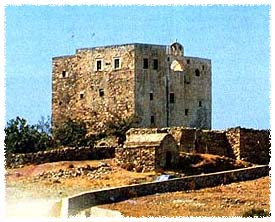
the towers, there are more than thirty today. In earlier times,
played the part of domination to the locals and they were also tower-monasteries
having a defensive character or they were the country domiciles
of Venetians.
Towers had auxiliary spaces, spaces for storage and stables as well.
They were of Western and Cycladic architecture because local artisans
for the Franks have constructed them. There were warehouses for
the yield and a wide reception room, which some year later extends
in more floors. Outward, there is a stone ladder that goes on the
balcony of the first floor where there is the main entrance. In
some towers the ladder doesn't reach to the entrance but stops in
a distance and continues with a wooden exedra-bridge that was ascending,
every time the invaders threatened the safety of the castle.
All towers have the colour of rock and ground and they go with the
natural ambience. Windows and doors decorate the towers in a single
way.
|

|